
Trump's Jim Crow came after me and my family
There is something dangerous happening to American democracy, and it does not always look like voter suppression.
Sometimes it looks like a spreadsheet.
Sometimes it looks like a computer algorithm.
Sometimes it looks like a letter telling you that your voter registration needs to be verified.
Sometimes it looks like nothing at all.
And that may be the most dangerous part.
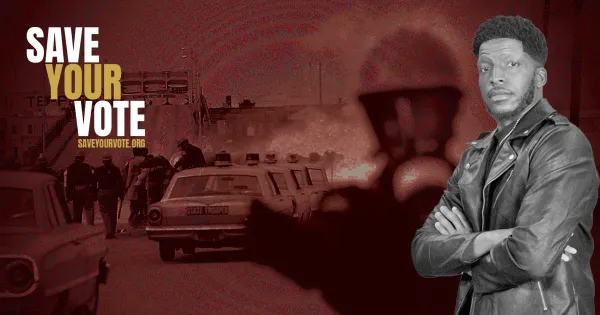
Edward Ward hosts the Jim Crow Reloaded series.
I have spent years working in communities, organizing voters, training young people, practicing restorative justice, and fighting for people whose voices are too often ignored. Today, as a Freedom Rider and Team Lead with the Transformative Justice Coalition and as the host of Jim Crow Reloaded for Save Your Vote, I find myself working on a question that is both simple and deeply uncomfortable;
How do you protect a right that people assume they already have?

Watch Jim Crow Reloaded: The Purge
That question has become personal for me. I grew up on the West Side of Chicago in a single parent household. My mother raised five children while navigating poverty and government assistance. I know what it means to live close to the edge. I know what it means to feel unseen by institutions. I know what it means to question whether your voice matters.
And I have learned something throughout my life… When people feel powerless, they are easier to govern. That is why voting matters.
Not because voting is some magical solution to every problem in America. It isn’t.
But because the ballot is one of the few mechanisms ordinary people have to exercise collective power over the institutions that make decisions about their lives.
Take away the ballot, make the ballot inaccessible, or convince people that their ballot will not matter, and you have weakened one of the most important tools people possess.
That is why I am part of the Save Your Vote effort.
The campaign’s premise is straightforward; voters need to know whether they are actually registered and whether something has happened to their registration before they walk into a polling place expecting to vote. Save Your Vote provides tools and information designed to help people check their registration and respond to potential problems before Election Day.
That sounds simple. It is. But simple does not mean insignificant.
The Palast investigative team has spent decades documenting how voter purges, faulty matching systems, voter challenges and other mechanisms can create barriers to eligible voters. The campaign points to previous investigations involving Florida’s felon purge lists and Interstate Crosscheck, as well as more recent research into voter roll purges.

Watch Episode 2: The Citizenship Game
And this is where I think Americans need to change the way we think about voter suppression. We tend to imagine suppression as someone standing at the door of a polling place saying, “You cannot vote.” That is the old picture. Modern suppression can be much quieter.
It can be a voter who never knows they were removed from the rolls.
It can be a registration problem discovered too late.
It can be a voter challenge that forces a citizen to prove their eligibility.
It can be a ballot rejected because of a technical requirement the voter did not understand.
It can be the accumulation of small barriers that disproportionately affect people who already have the fewest resources to navigate them.
And when those barriers are distributed across millions of people, the consequences can become enormous. This is why I don’t believe checking your voter registration is something you do because you are paranoid.
You do it because you are prepared.
We check our bank accounts.
We check our credit reports.
We check our flight reservations.
We check our medical appointments.
Why wouldn’t we check something as consequential as our voter registration? Especially when the consequences of discovering a problem after you arrive at the polls can be much greater than discovering it weeks or months beforehand.

Watch Episode 3: The Attack on Mail-in Voting
There is another reason this work matters to me. I am a minister.
My faith teaches me that human beings possess inherent dignity. That belief has shaped my work in communities just as much as my political education has. When I look at voting rights through that lens, I cannot reduce the issue to Democrats versus Republicans.
I see people.
I see seniors.
I see young people voting for the first time.
I see working parents trying to make it through another day.
I see people who have been told their entire lives that politics is not for them.
I see people who have every reason to distrust institutions but still deserve the ability to participate in them.
And I see the descendants of people who literally risked their lives for the right to vote.
The Freedom Riders understood something that we sometimes forget; rights do not protect themselves.
People protect rights.
People organize.
People investigate.
People educate.
People show up.
People get into what John Lewis called “good trouble.”
That is the spirit I bring to this work.
I am not a journalist by training. I am an organizer. I am an educator. I am a minister. I am a Chicagoan. I am someone who has spent years standing in rooms with people who have been told that their problems are too complicated, their communities are too difficult, and their voices are too small to matter. I know better.
And that is why Jim Crow Reloaded is not simply a documentary project to me.
It is an intervention. It is an attempt to take complicated systems and explain them in language that ordinary people can understand. Because what good is an investigative report if the person whose vote is at risk does not know what to do with the information?
What good is knowing that voter suppression exists if we do not give people the tools to protect themselves?
That is the space Save Your Vote occupies.